Tossed relentlessly by towering waves, radio communication down, rogue ice flows suddenly appear from nowhere, dogging the valiant skipper and his home built cruiser, “The Indomitable”.
Struggling frantically to pump the flooding cabin as waves crash over bow and rails, a thundering crash reveals evidence of collision, and a sperm whale surfaces alongside. Cracked and leaking, the doomed craft struggles on. Waves thirty feet high make navigational fixes impossible in the dark night, position unknown.
Morning light dawns at last and the sodden vessel in now in uncharted territory. Pale light reveals a faint shadow on the horizon. Saved! Without warning, a great white suddenly strikes taking off the bow of the craft, along with the bowsprit and the storm jib. Will he make it? Can anyone continue under such harrowing conditions? Ripping the tattered main from the mast and executing a hasty repair, a jury rigged vessel struggles on, with a patch of sail and duct tape.
What is that, the sound of breakers? The grinding sound of hull meeting hidden reefs below means only one thing…those breakers are going to carry the craft over the rocks and ashore! Grabbing a few essential tools from the cabin, the skipper flings them into the inflatable and abandons ship. Just in time, as she breaks into a thousand splinters of ply and epoxy, cast upon the white sands. Thrown end over end, the inflatable and its captain lie breathing their last upon the island’s empty shore. And the duct tape at the bottom of the sea!
Ok, this is the stuff that sailing disaster stories are made of, that have sold countless thousands of magazines and kept wives from going out sailing with you. I mean, is it fun, an adventure , if nothing bad happens?
Stories like this have fascinated me for years, along with the self-rescue, survival, finally found finales.
Which caused me to wonder, if lost like the Minnow, Gilligan and those ill-fated passengers, would today’s boat building sailors be able to get off that island? Just their skills and a few tools? Could they actually build something that would float, sail, paddle or row? So, having picked a few known builders of many boats, many categories, I asked…..could you get off that island?
Maybe, maybe not.
The iconic boat burner, Andrew Linn, replied “The only tool I would want to save from the sinking boat would be my acetylene torch. My plan would be to start setting everything on the island on fire and just keep burning until someone noticed and rescued me. Of course, that is my rescue plan under all circumstance.”
Not all builders leaned to fire. Mik Storer, Australian boat designer, might actually be able to get himself and the passengers off that island. I mean, Mik sails in waters like these in his home country. He does admit, “I think that I would have to change my boat building thinking a lot. My building approach depends on materials from out of a factory in terms of both materials and tools. Can I include a Honda 4 stroke generator and a 50 gallon drum of fuel rescued?”
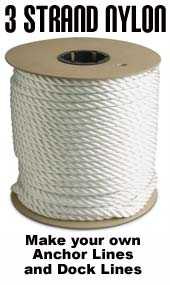
Mik added, “If I could not, then my tools would become something like an adze, broad axe, draw knife, a bit and brace with a nice bunch of hardwood and softwood bits, acres of rope, and lots of packages of matches.” Looking at that list, you can just see Mik felling trees, lashing them together, maybe burning out tree trunks for an outrigger canoe. I think he would get off and probably figure out a sail plan as well.
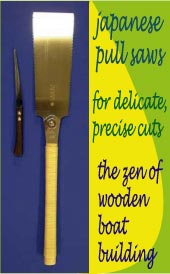
Canoe builder Skip Johnson when asked what tools he would want to have saved, replied, “First choice would be a satellite phone and a SPOT. For actual tools, probably a large sharp knife, with whetstone along with a good multitool and a pull saw.”
Chuck Leinweber is of the same mind as Skip. “I’d want a knife, an axe, a hand drill of some kind and a saw.”
Polysail’s Dave Gray has a similar wish list. “A good hand saw, an ax, a few hundred feet of ¼ inch double braided polyester line, and a big polytarp might be enough for a serviceable raft.” As a creator of polytarp sails, Dave would probably successfully fold and tie that tarp into a sail that would carry him across open seas.
“If I were stuck on a deserted island and wanted to build a boat to get off, I think a chain saw is what I would want.,” said Bobby Chilek. “I could use it to cut down trees and then with a little finesse, carve what parts I needed to build something.” Since Bobby is a native Texan, this not an unusual choice. Texans have been known to do unusual things with chainsaws, both good and bad. Remember the Texas Chainsaw Massacre?
Not all Texans resort to chainsaw finesse. Chris Breaux responded. “OK, this is a tricky one. This is where I ask, what kind of island? What is the predominant species of wood? Is this a deserted island with 110 and Wifi? If I can’t have that, then I would need a hammer and nails, big ones. Big bolts and nuts and I would settle for a crescent wrench with these. I would want rope, lots of rope.”
Chris added, “And a #%$@#$^ plane.”. The plane is the one tool Chris acknowledges he cannot master, yet is one he feels he would need to build a rescue boat. “Maybe it’s because I can’t get the thing to shave the right amount, maybe it is because I do not keep it sharp enough.”
Puddle Duck Racer builders tend to be a minimalist, survivalist and just plain improvisational group. Somehow I feel those Ducks would get off that island. Jason Nabors of Tenacious Turtle fame is certainly all of that. Jason said, “I would want to have saved my shingle hammer. It has a hammer on one side and an axe on the other, where a normal hammer could have a claw for pulling nails. I took one with me on the TX200 and it was used almost every day. That is the best piece of sailing equipment you will ever own. Well, that and a real rigging knife, the one with the marlin spike and the shackle key.”
Tim Cleary of North Carolina hosted this year’s PDR World Championship races. He is equally minimalist in tools to build a rescue craft. All Tim wished for was a sharp axe, a knife, a sledge hammer and a wedge.
Seeing photos of the Duckers carving rudders, lee boards and other boat parts from drift wood scraps, rigging sails with axes, you somehow have the feeling that if lost on a deserted island, you just might want it to be with a Ducker. After all, until the Ducks I had never known a sailor who routinely carried an axe. I am not sure most of the sailors I knew previously even owned an axe!
In the far north, Tom Pamperin had similar but expanded wish lists for survival. Tom listed an axe, a plane, a spoke shave, then added, “A few gallons of epoxy, some mixing pumps, and a good sharpening stone, might do it. And line, lots of line. Shipwreck victims always seem to end up lashing a bunch of stuff together. A hand drill would be nice and could double as a coconut opener when you get thirsty.”
Paddlers often think along different lines, as does Kellan Hatch of Utah. “If I had a large enough log I’d go for a dugout boat. Alberto Torroba sailed thousands of miles in one. My tools for that would be matches, an adze, a pocket knife and a cold can of Pepsi. Matches to build a fire to burn away as much wood as possible. The adze for the shaping of the hull. The knife for whittling paddles and other parts and the Pepsi to reward myself for a job well done.”
“Deserted island?” asks Phil Lea of Arkansas, “Handsaw, hammer, brace and bit, hand plane. Scoop of vanilla, scoop of chocolate, don’t waste my time. Borrowed from City Slickers.”
Simple tools make up Kevin Nicolin’s list as well. “I guess I’d want to salvage a saw, a plane, hammer and nails, and, if available some epoxy. Oh yeah, I’d also like to salvage Charlie Jones!”
Charlie responded that if thrown onto an uninhabited unknown island, he would wish for salvaging a Japanese pull saw, several planes and a couple of good chisels. “ Plus a sharpening stone…that makes the chisels and planes work. No stone, no good on the chisels or planes.” Charlie Jones is someone I would expect would not only get a rescue craft built, but it would look like a boat.
Now, what is the relevance of thinking about how to build a boat with limited tools and no power, no convenience speed building methods we have all come to rely on? It was reading about instant boats, stitch and glue methods and other time saving techniques. I am not that old, yet I realized the entire boat building world had been changed by these very methods within my lifetime. Our ancestors built boats for centuries with only a few hand tools, no power, no epoxy. Those boats successfully sailed and may or may not have been beautiful or finely crafted, although I suspect many were. Could today’s builders of home built crafts duplicate anything similar?
There is something to be said for planing, scraping, cutting, fitting wood. It is a satisfying activity, hypnotic and soothing, whether done on a deserted island or your home garage. Yet many builders seem to avoid it, reaching for the power tools and eschewing hand work.
So, I started thinking of our ancestors, who tied together bundles of reeds, grasses, whatever wood they had available, to create craft that plied the waters of America, Europe and Africa, the Polynesians of the Pacific, the boats of the East, China, the Indian Oceans. The Norsemen came across the Atlantic to America, even reaching my home state of Oklahoma, far inland. They did this in boats they built with hand tools, axes, adzes, chisels, yet these boats survive today, legacies to a tradition of hand building centuries old.
Discussion often arises in boating circles of building Norse boats or other similar reproduction craft. I wonder about the skills of the hand tools used to create them, almost gone and lost. Would today’s builder make his Norse boat of ply and epoxy? Would he build it the way of the originals? It can be done and they can sail again. Yet these skills are today largely relegated to maritime museums and their students.
So, like the castaways in all those survival after the disaster stories I have read that made me swear “We are NOT crossing a body of water that large in a boat this size!” I find myself thinking of survival and skills needed. But it is actually the skills necessary to build that I think about. Our forefathers took these as a given, there was no other way. Today’s builder has other ways, but keeping the old along with the new, a survival of a legacy of boat building going back forever to the beginning of recorded time seems precious to me.
Ask yourself my question, “Could I get off that island?” |